A large number of businesses are still using outdated lighting solutions for their workspace and with the rising cost of electricity, more and more businesses are converting to energy-efficient lighting solutions (LEDs) that not only last longer, but help slash energy bills by up to 70%!
LEDs have become more affordable than ever and with retrofit options available, it might not even be necessary to change your fittings to fit the lamp. It’s obvious that companies want to save on overheads where they can (especially with the rising energy prices), and as a result of switching to LEDs, they’ll help reduce CO2 emissions, assisting in tackling the ongoing climate issues we all face.
What’s Involved in a Lighting Scheme?
A lighting scheme or lighting survey is where an expert helps highlight any lighting issues in your workplace. Some examples of what we would look for are:
Lighting effects
Correct design
Correct installation and maintenance
Help with disposal
Selection of functional emergency lighting
The journey begins when you make an enquiry about a lighting survey. We visit site and check out the current lighting situation with one of our trusted lighting suppliers. While there, we look at the current setup, discuss and identify areas for improvement, with the goal being to save you money, over time, through efficient lighting solutions. Any special requirements will be noted. These can be things such as the room needing a waterproof fitting or some other sort of protection against hazardous areas, colour matching tasks, etc.
After taking notes and measurements, we’ll have a discussion with you on your desired lighting effect. This can vary from just wanting a simple off/on switch function, to having motion sensors in chosen areas, to possibly introducing smart lighting functionality into the mix. At the end of the day, it’s up to your desires and budget.
Once we’re all on the same page on the new desired lighting setup, we then send this information to the technical team and they come back to us with an in-depth description of what fittings & lamps you will need and how many. You would get the full drawings that illustrate the beam angle and light saturation of your new lighting, and more importantly, you’d get a full energy saving calculation. This calculation runs your current lighting against the recommended ones, to show you the cost and carbon emission you would be saving, over a 12-month period.
On average, it can take 5 working days from visit to the specifications and drawings to be prepared but it’s worth the effort if you plan on saving money in the long run.
Sound Promising?
We hope this article has helped bring you insight into what goes on when you enquire about a lighting survey for your workplace. We help shape your vision and requirements for a more efficient, low emission lighting solution.
So, whether you’re in a commercial or industrial space, we can assist you with upgrading your lighting and thus, saving your business money, in the long run.
Get in touch by either email or phone today for your lighting survey!
For more information about LEDs and their benefits against fluorescent, halogen and incandescent lamps, check out our article on it here.
The government’s recent move to prohibit the production of fluorescent and halogen lamps from August 2023 has left a lot of companies uncertain as to what happens next.
There are still a number of businesses that are not in a position to change over to LED lighting just yet, or that don’t have an LED equivalent to change to, so we thought we would shed some light on what happens now.
What’s the situation?
Lamp Type
Date Phased Out
Compact fluorescent lamps type PL with separate ballast
February 2024
T8 fluorescent tubes
August 2023
T5
February 2024
T5 tubes in emergency fittings
February 2027
Most sodium (SON) lamps and metal halide lamps will continue until February 2027.
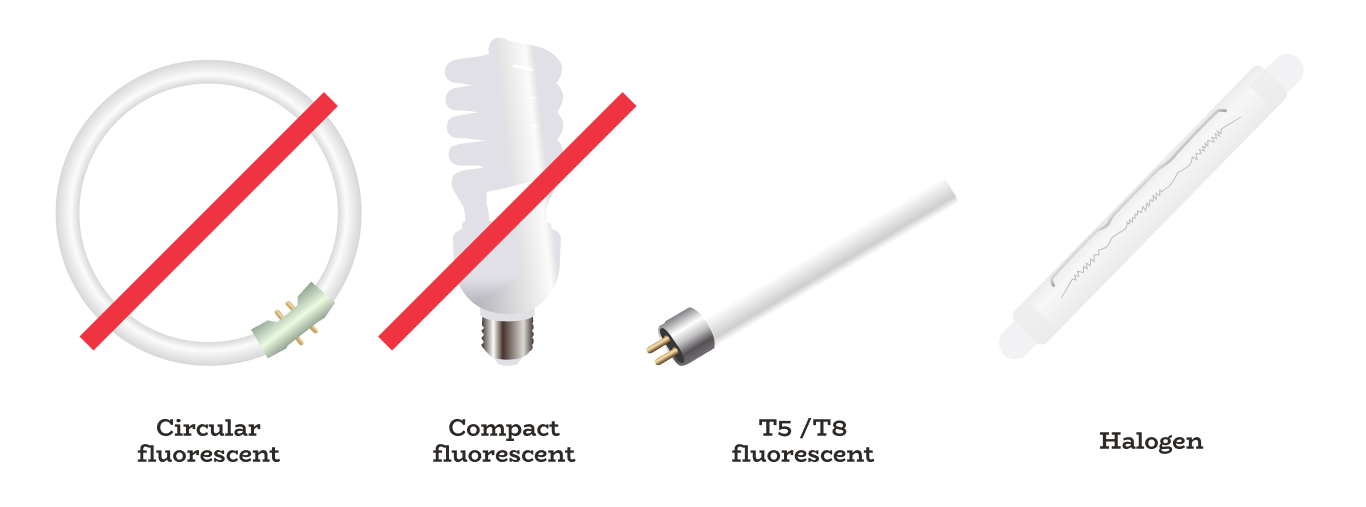
Whereas LED tubes are more energy efficient than fluorescent tubes, the prohibition is actually an RoHS directive (Restriction of the use of Hazardous Substances) and is concerned with removing lamps and tubes which contain mercury.
Already this year, the ban has been applied to circular tubes and compact fluorescents (where the tube is folded or spiralled into a small profile).
At present, T8 and T5 replacement tubes can be cheaper to buy than the equivalent LED tubes, and by continuing to use them companies can avoid the cost of installing new fittings. As fluorescent tubes get scarcer the price in the market will rise, though.
When it comes to disposing of old fluorescent tubes, there are strict rules for their recycling, since the mercury content is classified as hazardous waste. We will continue to offer our tube collection and recycling service, complete with the required audit trail as required by the Environment Agency.
The ban only applies to the production of new lamps, not lamps that have already been produced. This means that if it’s on the shelf, it can be supplied by us while stocks remain.
In expectation of the upcoming ban, we have significantly increased stock holdings on fluorescent and halogen lamps so we can minimise disruption to our customers’ businesses, helping to keep critical areas lit while they plan their move to LED lighting.
What’s next?
By virtue of the fact that LED lamps and fittings last for many years, arrangements for recycling LED lighting from commercial premises are still somewhat patchy. In terms of recycling and disposal, LED fittings need to be treated more as electrical devices rather than traditional luminaries.
If you are considering exchanging a bulk installation of LED lighting, let us know and we’ll be pleased to help!
Quick question, does your company have the facilities to cater for employees with electric vehicles?
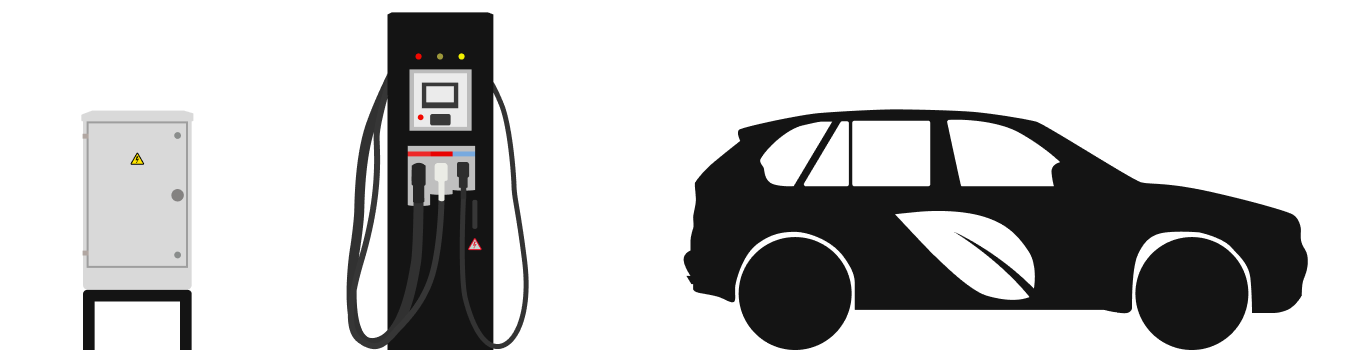
If the answer is no, but you would like that to change, look no further. We have recently put one of our customers in touch with our contractor to install feeder pillars and solve their EV charging problem.
As more electric vehicles are being introduced to the market, charging stations are needed to facilitate these eco-friendly modes of transportation to businesses, institutions and public spaces.
Luckily, finding the right feeder pillar for your EV charging needs or other outdoor power applications is rather straight-forward.
Feeder Pillars for your Business
As you are probably aware, vehicle carbon emissions have a major impact on global warming and, as a result, governments are looking at sustainability projects with the focus on rapid deployment of net zero solutions. Hence electric vehicles (EV) the need for EV charging stations. The UK government has incentivised EV charging (as we will go into detail further down) and with the ease of implementation, now is a good time as any to make the change!
Thanks to our approved supplier Lucy Zodion, with their new EVIS (Electric Vehicle Infrastructure Solutions) pillar range, the support for implementation of EV charging networks across both public and commercial markets have been made so much easier.
The EVIS pillar range are designed to meet a wide range of application requirements (not just EV-specific), from 100A to 630A.
The EVIS pillar range come in various configurations, allowing you to select the correct layout to fit your business’s needs.
You should keep in mind how many EV charge points are needed, as well as their rating. The EVIS range are designed to meet all onsite layouts, including mixed EV charge points. This includes both single-phase and three-phase from 7 kW to 50 kW.
Now we could go into more technical detail about these feeder pillars but its best we leave all those specifications for the installer. If you need an installer, get in touch and we’ll get you connected to our trusted contractor.
Don’t worry if your concern is about the upfront cost of things, as the government incentivises workplace charging thanks to the Workplace Charging Scheme. The GOV.UK webpage on Grant schemes for electric vehicle charging infrastructure states that “The Workplace Charging Scheme (WCS) is a voucher-based scheme that provides support towards the up-front costs of the purchase and installation of electric vehicle charge-points, for eligible businesses, charities and public sector organisations.” This means you can save money on the implementation of EV charging stations partly thanks to the government incentive, but this also suggests that other businesses and public spaces will most likely be implementing EV Charging stations as well, which in turn, will make electric vehicles more mainstream, viable, and future-proof your business.
Update March 2026: This grant has been extended until 31 March 2027. From 1 April 2026 the maximum grant will increase from £350 to £500 per socket.
Conclusion
In summary, the government want to cut gas emissions and electric vehicles do just that. As the ownership of electric vehicles increases, so will the demand for EV charge points and thanks to the Workplace Charging Scheme, implementation of such charge points has been made an easier decision to make, from a financial standpoint.
We have already helped some of our customers with implementing EV charging for their business and we’ll be happy to help more of our customers make the change or just solve any and all EV-related enquiries.
If you’re interested more in EV charging, visit our EV Charging page!
There are so many lighting options these days that it can be quite a daunting task finding the right solution for your environment. Halogen and fluorescent lamps and tubes are being rapidly phased out in favour of LED lighting, but what makes LED so appealing?
LEDs, Halogens, and Fluorescents – Key Points
You will undoubtedly be aware that LEDs have overtaken traditional lamps within the lighting industry, but even though LEDs can have a higher upfront cost, there are long-term benefits that make them clearly worth the investment.
It is remarkable to think that the commercialisation of incandescent bulbs by Joseph Swan and Thomas Edison was less than 150 years ago in the latter part of the 19th century. However, incandescent bulbs were the first casualty from the traditional line-up of incandescent, halogen and fluorescent lamps, having been banned from sale in 2018. The UK Government published a press release in June 2021 to advise halogen lamps would be banned from September 2021, and fluorescent lamps from September 2023. However, the Lighting Industry Association (LIA) later clarified that only certain types of lamp are actually included in the ban.
Technology may have advanced a long way since the days of Swan and Edison, but the ability to cheaply mass-produce traditional lamps has kept them viable in the marketplace. However, the energy efficiency of LED lamps and fittings offers an unmissable opportunity to businesses and governments around the world finding themselves under pressure to meet the challenge of climate change.
It should be noted that although UK regulations ban the manufacture and import of certain traditional lamps, any stock currently held by your friendly local wholesaler is still legally available to buy!
Halogen Lamps
Halogen lamps are an evolution of the standard incandescent bulb, where the addition of halogen gas sets up a reaction that causes evaporated tungsten from the filament to return to the filament rather than accumulating on the inside of the lamp. This extends the life of the filament and helps prevent blackening of the lamp. Halogen lamps can operate at higher temperatures, provide bright light, and illuminate immediately from being switched on. This led to them being widely used in floodlighting and display lighting, although LED lamps and fittings have largely replaced them in recent years. While more energy efficient over incandescent bulbs, they do not hold a candle to LED lamps (if you’ll permit the pun).
Halogen lamps are around 85% less efficient than LEDs as most of their energy is wasted as heat energy, making them more costly in the long run, not to mention uncomfortable for people who have to work near them all day! They need careful handling, both because of the heat they produce during use, and because oils carried on the skin can weaken the glass and shorten the lifespan of the bulb.
Fluorescent Lamps
Low-pressure mercury-vapour gas-discharge lamps – something of a mouthful, and from the name alone they sound quite dangerous… and to an extent, they are! Fluorescent lamps and tubes work by exciting mercury vapour with electricity, which generates ultraviolet light. The UV light reacts with a layer of phosphor that coats the inside of the lamp, generating the visible light we see. Unfortunately, mercury is quite unpleasant so fluorescent lamps need to be disposed of properly, and broken lamps present a health hazard. As a side note, we provide a service to safely collect and dispose of used fluorescent tubes should you need it.
A fluorescent lamps (and its somewhat shorter cousin the compact fluorescent lamp, or CFL) is far more energy-efficient than a traditional incandescent light bulb or a halogen lamp, but still cannot match the efficiency of LED in terms of lumens output per watt.
Although fluorescent lamps have historically been cheaper than LED lamps, they lose their energy efficiency over time, requiring more and more voltage for the same amount of light. Eventually the voltage exceeds the fixed resistance of the ballast (which is required to regulate the flow of current in a fluorescent lamp to stop it from self-destructing!) causing the lamp to fail and need replacement. Finally, the light is omnidirectional, which is not always an advantage, for example when a fluorescent tube is ceiling mounted; in this case, the half of the light pointing at the ceiling is wasted unless otherwise reflected back out of the fitting.
LED Lamps
Light emitting diodes (LEDs) produce light through the recombination of electrons and electron holes in a semiconductor. It sounds complicated and it is, but basically if a semiconductor contains impurities (intentionally, via a process called doping) then additional free electrons can be added, as well as holes where free electrons can go. Free electrons can “fall into” available holes releasing light energy in the form of photons. As a long-term investment LED lamps have a number of advantages, including a long lifespan (up to 50,000 hours), lower maintenance costs, and lower energy bills. LED lamps can be more expensive than traditional lamps, but have become much more affordable in recent years.
Due to their small size, LEDs can be used in a variety of lamps and light fittings, making them incredibly versatile. Many modern fittings are now colour selectable (also known as correlated colour temperature, or CCT), allowing installers to switch between two or more different colours of white for a cooler or warmer effect. Colour temperature, often measured in degrees Kelvin can affect how light is perceived by the observer. Lamps at the warm end of the spectrum (around 2700K) are usually used in relaxed settings, such as living rooms, bedrooms and restaurants. By contrast, lamps at the cool end of the spectrum (4000K and above) are usually associated with professional environments. Very cool light, often referred to as daylight (around 6500K) can be uncomfortable to work in, often feeling very clinical. Colour temperature is separate from colour rendering index (CRI), which is important if you need accurate colour rendition, for example in hospitals or in the textiles or printing industries.
Some other benefits of LEDs are their vast spectrum of visible light colours and light quality, making them versatile for many applications including ambient lighting, display lighting and accent lighting. Their brightness, energy efficiency and ability to illuminate immediately from switch-on has made them ideal for floodlighting and street lighting.
It’s also worth noting that with regards traditional lighting, it was common to measure the performance of the lamp in watts, however with LED lamps and fittings the lumens output is one of the important factors to consider.
In Summary
LED lamps are vastly superior to other lighting solutions, in terms of versatility and efficiency
Inefficient lighting solutions are being phased out by governments around the world
You could be saving money by investing in LED lighting solutions today
Where possible, you should definitely consider switching your current lighting to LED lamps and fittings, as the long-term investment is just too good to ignore. As halogen and fluorescent lamps become scarcer, the cost saving that once made them attractive will disappear, while the cost of LED lighting will continue to decrease over time. The long lifespan of LED can reduce the frequency of replacing bulbs and tubes, and of course, there are the ongoing savings of using less power at a time where energy prices look set to go nowhere but skywards. Overall, it seems a much wiser bet to go for the versatile and extremely energy-efficient LED option.
We can help you with your lighting requirements, including lighting surveys and used lamp collections – get in touch!